
Marguerite Duras
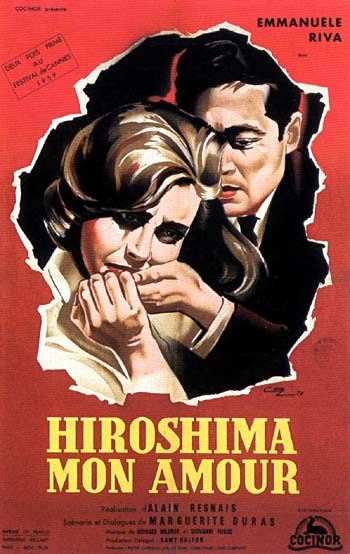
HIROSHIMA mon amour (1959)
Directed by Alain Resnais
Emmanuele Riva and Eiji Okada
Quotes translated by Mandi
I was reading about new releases on DVDs from the paper somewhere in fall 2006 and noticed Hiroshima Mon Amour. I hadn't heard about it yet, and I couldn't find it in the film books my dad had, books that were called Films Bigger Than Live. Few months later I went to the library, and there it was on the shelf, waiting for me. I picked it up out of curiosity and well, I also thought it would be good practice for my French. It intrigued me from the very start.
The first time I watched it through I was unbelievably touched by it. It was an incredible experience for me and I was completely blown away how accurately it could describe people, motions, situations. The dialogue was amazingly clever. But every time I watched it again, I was amazed by different things. The dialogue, the filming, the cutting, the music... It touched me so deeply, that I felt almost shocked. Almost every time I watch it I cry again for its mere ability to describe things I've tried so hard so many times so perfectly. I cry again for its ability to make me realise and understand. I was shocked that one could do so much and so accurately with cinema. This was without a doubt A Film Bigger Than Life for me.
"I have always cried over the fate of Hiroshima."
"No. What there was for you to cry over for?"
A human being suffers so they would not forget. After remembering they had forgot they suffer because they had forgot they had suffered. Sounds complicated and it is.
What does Hiroshima mean for us who did not know it until it was destroyed, whose hometown it wasn't or just part of their country? And what does it mean especially for western countries? The end of the war. Peace. Museums. Documentaries. Efforts made for not forgetting. And fear of forgetting, fear of indifference.
"The whole world was rejoicing. And you were rejoicing with the whole world."
And who were the monsters of the World War II? The Germans and the Japanese (the woman had a German lover during the occupation of France).
The woman has been to the museums, seen the reconstructed photographs and films, all the effort of creating a perfect illusion of what happened 14 years ago.
"Just like there is illusions in love that you can never forget... I believed I could never forget Hiroshima, just like love." At the same time, the shuddering clips of the bomb's victims and destruction change into clips of reconstruction, cenotaphs, a tourist tour bus. Nature forgets too, little by little it grows grass back, River Ota flows just like it used to...
The woman, actress, is shooting a film in Hiroshima. The film is about peace for "what else could you film in Hiroshima?" Just as she cannot think of her hometown Nevers, France, without the one she loved there. The man wants to know everything about Nevers and the woman insists on knowing why.
"I'm just getting to know you. And from thousands of things that have had an affect on your life I chose Nevers. -- I almost lost you there. The risk of not ever coming across with you. Somehow I understood that there you began to be the person you are now."

***
Well this is all I want to say about this movie, watch it yourself and figure out the rest, I don't want to spoil it. But after you've seen it, I'd love to talk about it with you. Just one thing... Hotel New Hiroshima.
La Marseillaise: little Japanese kids dressed in traditional "fighting outfits" (?) and marching.
ps. if I were to choose one movie or a piece of art this would be it. definently.

Ei kommentteja:
Lähetä kommentti